

Choosing a data center: what to check and ask
An accounting office decides to move the server holding its clients' files out of the office cupboard and into a data center. The three offers in front of it look alike: all of them say "redundant power", "24/7 support" and "99.9%". Choosing a data center is about opening up what lies beneath these sentences. This article lists, in order, the questions to ask before colocating a server or renting a rack; under each heading it says what to ask for in writing and what you can measure yourself.
Location and latency: measure it yourself
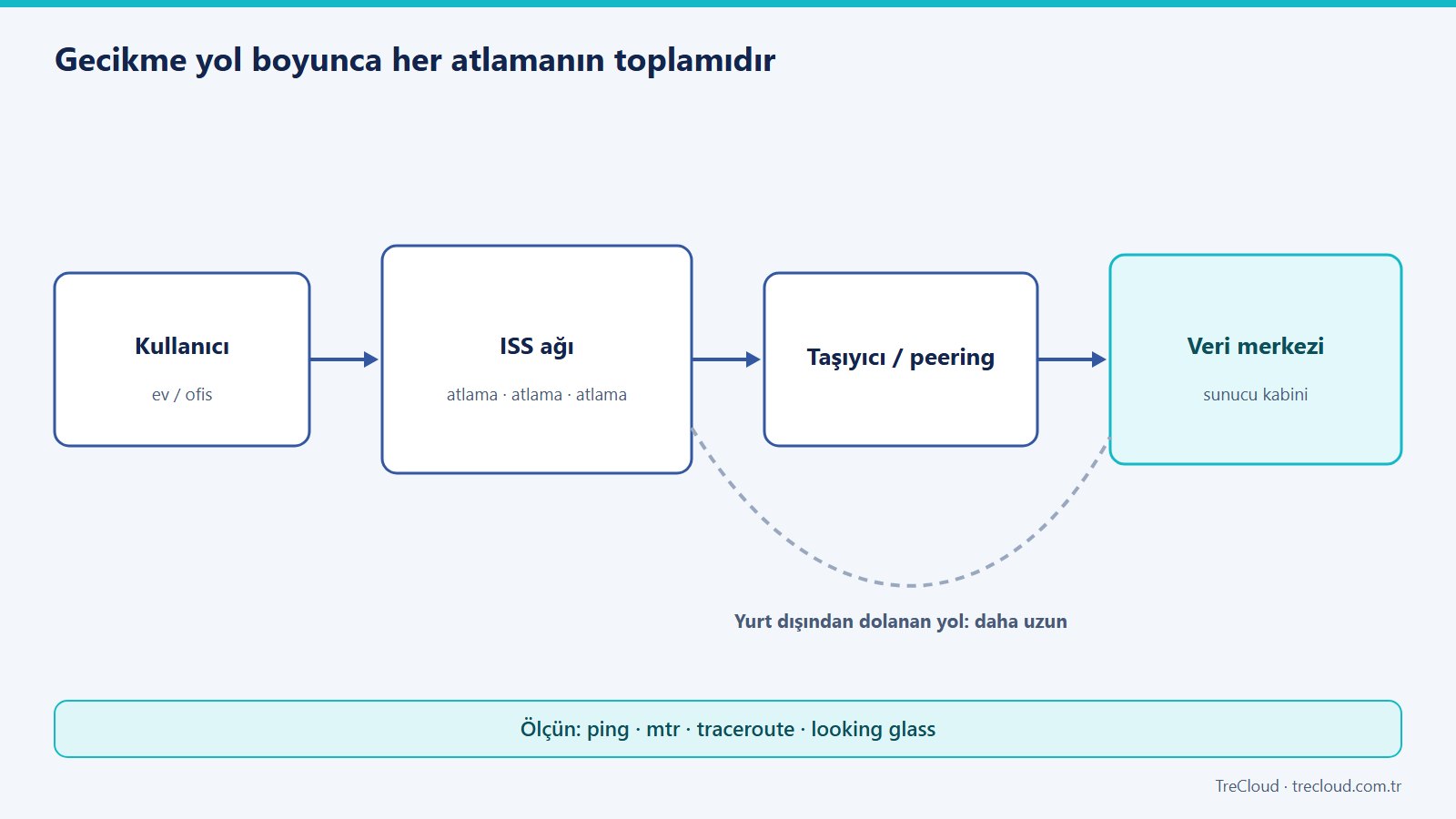
If your users are in Turkey, having the server in Turkey usually lowers latency. But distance alone does not decide latency. Which operators the packets pass through, whether the route leaves the country and comes back, and evening congestion all change the result. Two users in the same city can get different results through different internet service providers (ISPs).
So trust your own measurement, not the millisecond figure in a brochure. Most providers offer a looking glass tool: you run ping and traceroute from the provider's network to your IP address. TreCloud's looking glass page is there for this. Measure the reverse direction too, from your own office and from the lines your customers use:
ping -c 20 target-ip
mtr -rwc 100 target-ip
traceroute target-ip
On Windows use tracert target-ip and ping -n 20 target-ip. Look not only at the average but also at variation (jitter) and packet loss. If the route detours abroad, you will see it in the names of the intermediate hops in traceroute and in sudden jumps in latency. Repeat the measurement in the morning and during evening peak; a single measurement is not enough for a decision.
Power and cooling redundancy
When grid power fails in a data center, the load first moves to the uninterruptible power supply (UPS) and then to the generator. The question to ask is not "is there a generator" but "what happens if a single component fails". Redundancy is usually described as N+1 (one unit more than needed) or 2N (two independent full sets). If two separate power feeds reach the rack and your server has two power supplies, a failure on one feed does not shut your server down. A server with a single power supply, however, hangs on one feed even in the most redundant facility.
Cooling is read with the same logic. Can the other units carry the load while one cooling unit is under maintenance? Are hot and cold aisles separated? Are generator tests planned and announced? The answers to these questions should be written, not spoken.
At TreCloud, critical systems are redundant; power and generator details are given in writing in the offer. Whichever provider you talk to, ask for this written table instead of the sentence "everything is redundant", and ask how your own hardware will be connected to that arrangement.
Network, carriers and peering
A data center connected to a single upstream goes quiet when that operator has an outage. Ask how many carriers it connects to, whether these connections enter the building over different physical routes, and whether the backbone devices are redundant.
Peering is the provider exchanging traffic directly with other networks. Well-established peering relationships shorten the route and lower latency. Check whether the provider publishes its peering policy; TreCloud's policy is written on its peering page.
Port speed and usable bandwidth are not the same thing. A 1 Gbps port does not mean you will carry 1 Gbps of traffic at every moment; the committed rate, traffic quota and overage terms should be in the contract. Also ask in writing whether DDoS protection is included, what happens to your traffic during an attack and who decides. If you will connect from your rack to another customer or operator, see the cross-connect fee and setup time in the offer.
Physical security and the building
Physical security is the question of who can touch your server. Badge access, camera recording and how long recordings are kept, visitor logs, rules for unescorted entry and who holds the rack keys are the basic questions. Some facilities have extra measures such as a two-door entry booth; what matters is not only that a measure exists but that it is logged.
Look at the building itself too: fire detection and suppression, flood risk, vehicle and goods access. Because much of Turkey lies in an earthquake zone, also ask about the building, how racks are anchored to the floor and the incident procedure. At the offer stage ask: "Who can touch my server, and with what record?" The answer should be a procedure, not a name.
Certificates: what does ISO 27001 prove, and what does it not?
ISO 27001 shows that an organization has set up an information security management system and that an independent certification body has audited it. It says risks have been identified, controls defined and regularly reviewed. But on its own it does not prove that there will be no outages, a particular level of power redundancy, or that your server is securely configured; your operating system and application remain your responsibility.
When you request the certificate, read three lines: the scope (which facility and which services), the validity dates and the certification body. TreCloud's certificates, including ISO 27001, were issued by EKOL and are valid from 20.02.2026 to 20.02.2027; the set also includes ISO 9001, ISO/IEC 20000-1, ISO 27701, ISO 14001, ISO 50001 and ISO 10002. We covered what ISO 27001 tells a data center customer in a separate article. Facility ratings such as Tier are separate from ISO certificates; if a provider states such a rating, ask for that certificate too.
How to read an SLA
A 99.9% availability target means roughly 8 hours 45 minutes of downtime allowance per year, or about 43 minutes in a 30-day month. But the details beneath the number matter more than the number: is the measurement window monthly or yearly, are planned maintenance and customer-caused faults excluded, how much service credit is given if the target is missed and within how long must it be claimed? Also check what is measured: power and network access, or your application? Application availability is usually outside the SLA.
| Question | Where to look |
|---|---|
| Measurement window and exclusions | Service agreement |
| Service credit and claim period | Service agreement |
| Planned maintenance and live status | The provider's status page |
At TreCloud the SLA is defined as a "99.9% target"; credits, the measurement window and exclusions are written in the service agreement, and live status is shown on the status page at /status. We discussed in detail why the number means little on its own in our SLA article.
KVKK and where data lives
Turkey's Personal Data Protection Law No. 6698 (KVKK) makes the transfer of personal data abroad subject to separate conditions, and these provisions changed in 2024. Having the server in Turkey simplifies part of this discussion but does not settle all of it. Your backup, email, support software or a cloud service you use may be keeping data in another country.
First draw your own data map: which data sits in which system, in which country? Then ask the provider: which facility holds the data, where are the backup copies, in which cases does the support team access your data, who are the subcontractors? TreCloud's data center is in Kahramanmaraş. We covered the architectural side of the in-country data requirement in our in-country data article; for current legislation and board decisions see kvkk.gov.tr.
This section is for general information and is not legal advice; clarify your obligations with your legal adviser.
Remote hands, support and visits
If your rack is in another city, you do not want to travel for a loose cable. Remote hands means data center staff doing physical work on your instructions: restarting a server, checking a cable, replacing a disk, sending a photo of the error on the screen. Ask which tasks are included and which are charged, how a request is opened, the night-time response time and whether the work is logged. Details are in our remote hands article.
Ask to see the facility before deciding. During the visit look less at blinking lights and more at cable management, rack locks, the entry logging process and how staff answer questions. We collected what to look at in 12 points in our data center tour article. At TreCloud support runs 24/7; for scope and offer questions you can use the offer form.
Exit plan: write the exit before you enter
One day you may change provider. When signing the contract, read the exit clauses too: the termination notice period, in what format and how quickly your data will be handed back, how long old copies take to be deleted and the day your hardware can be collected.
IP addresses usually belong to the provider and are taken back when the service ends. So lower the TTL of your DNS records a few days before the move and plan the switch to the new addresses. Using portable standards also makes the exit easier: S3-compatible storage, common virtual disk formats and documented configuration turn the exit from a month-long project into a planned day.
Short summary: the list to take to the negotiating table
When comparing offers, put a written answer next to each line. A line without an answer comes back later as a surprise:
- Latency: your own measurement with looking glass, ping and mtr.
- Power and cooling: a written redundancy arrangement.
- Network: number of carriers, peering policy, DDoS scope.
- Physical security: entry and logging procedure.
- Certificates: scope, validity date, certification body.
- SLA: measurement window, exclusions, service credit.
- KVKK: where data and backups live.
- Remote hands: scope, fee, response time.
- Exit: data handover, IP addresses, notice period.
Frequently asked questions
Is keeping the server in Turkey always faster?
If your users are in Turkey, usually yes, but the route between operators is what decides. Make the decision with your own ping and traceroute measurements.
Does a data center with ISO 27001 never have outages?
The certificate is not a guarantee of uninterrupted service. It shows that information security is managed systematically and audited; the availability target is written in the SLA and the contract.
How much downtime per month does a 99.9% SLA target mean?
About 43 minutes in a 30-day month. The measurement window, exclusions and credit terms are written in the service agreement.
Is having the server in Turkey enough for KVKK?
Not on its own; the data in backups, email and other services you use matters too. Clarify your obligations with your legal adviser.
Comments0
No Comments Yet
Be the first to share your thoughts.
Please sign in or sign up to leave a comment.